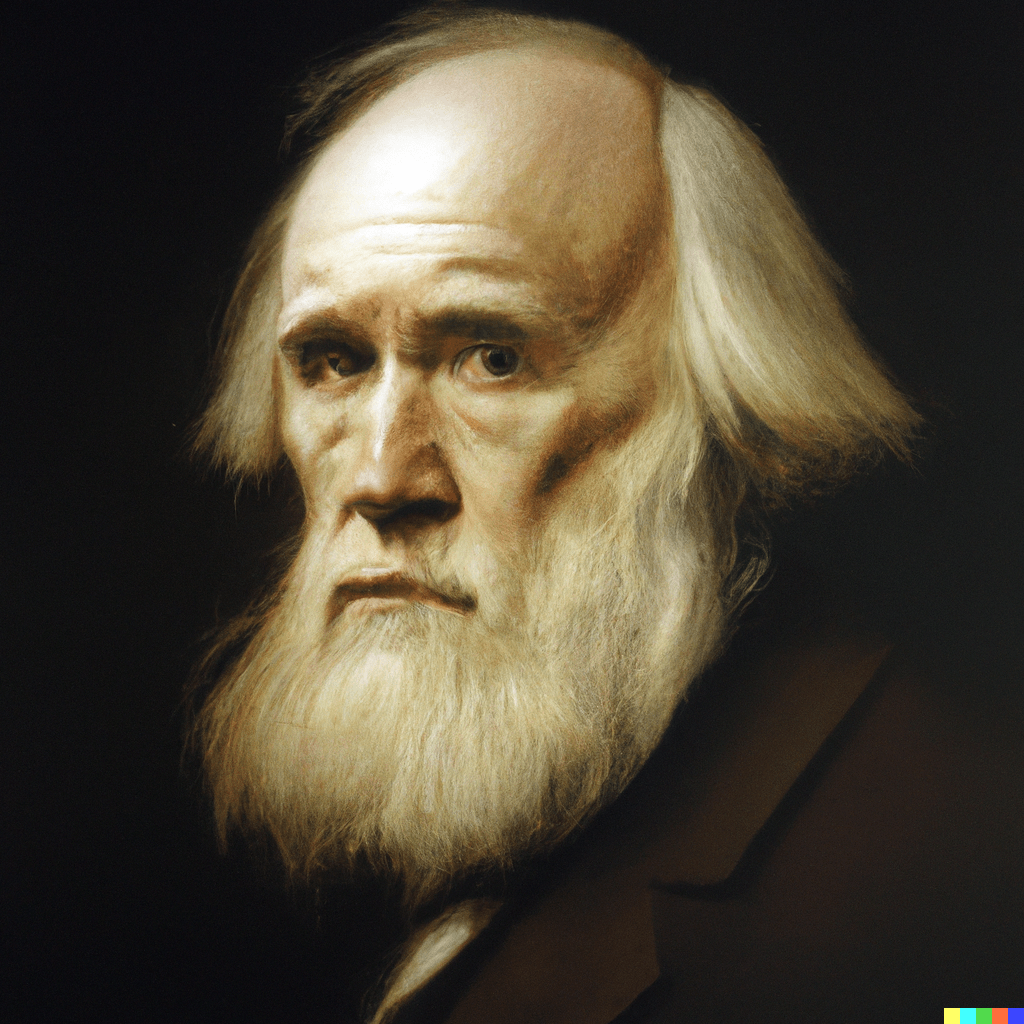
Charles Darwin (1809-1882) was a British naturalist and biologist who became one of the most influential figures in the history of science. He is best known for his groundbreaking theory of evolution by natural selection, which fundamentally changed the way we understand the diversity of life on Earth.
Born in Shrewsbury, England, on February 12, 1809, Darwin came from a family of prominent physicians and scientists. Despite initially studying medicine at the University of Edinburgh, his passion for natural history led him to pursue a more unconventional path. He later enrolled at Christ’s College, Cambridge, where he studied theology and natural sciences.
In 1831, Darwin embarked on a momentous voyage aboard the HMS Beagle as the ship’s naturalist. This five-year journey took him to various locations, including South America and the Galápagos Islands. During this expedition, Darwin collected an immense amount of geological and biological specimens and made numerous observations that would lay the groundwork for his evolutionary theory.
Upon his return to England in 1836, Darwin devoted himself to analyzing and organizing his findings. In 1859, he published his seminal work, “On the Origin of Species by Means of Natural Selection.” In this revolutionary book, Darwin presented his theory of evolution, proposing that species change over time through the process of natural selection. According to this theory, individuals with advantageous traits are more likely to survive and reproduce, passing on those favorable traits to their offspring, leading to gradual changes in populations and the formation of new species over time.
The publication of “On the Origin of Species” sparked intense debate and controversy, challenging prevailing religious and scientific beliefs of the time. However, over the years, Darwin’s theory gained widespread acceptance within the scientific community and is now considered one of the cornerstones of modern biology.
Charles Darwin’s contributions extended beyond evolution. He also conducted research on subjects like geology, botany, and animal behavior, and his work laid the foundation for fields such as evolutionary biology and paleontology. Darwin’s commitment to rigorous observation, systematic analysis, and his willingness to challenge established beliefs has left an indelible mark on the scientific community and continues to shape our understanding of the natural world to this day.
 CHANDAIYA Newsgraph
Leave a comment